Monday, March 23, 2009

DINE: DRINK: DONATE: The Tap Project in Minneapolis

Hungry Jack Lake, Grand Marais, MN

This week, all residents of Minneapolis are encouraged to drink Minneapolis tap water in lieu of bottled water.

Why? Mayor Rybak has declared March 22, 2009 World Water Day and March 22nd-28th World Water Week.

The skinny from the Tap Project web site:

Started in 2007 in New York and launching in 2009 in Minneapolis the program takes place during World Water Week, March 22 to March 28, 2009, and asks diners at participating restaurants to donate $1 or more for the tap water they usually enjoy for free.

The funds go directly to provide clean water and filtration systems to those in need, across the country and around the world. Your dollar contribution will provide clean water to a child for 40 days.

The Tap Project brings to Minneapolis an incredibly simple concept to encourage restaurant patrons to help bring clean and safe water to the children of the world, said Mayor Rybak. Let's challenge others through our example. In addition to donating at local restaurants during this week, I encourage Minneapolis resident's to drink tap water in lieu of bottled water. Let's make sure this precious commodity is available for generations to come.

During this week all residents of Minneapolis are encouraged to drink Minneapolis tap water in lieu of bottled water. Minneapolis water is a safe, clean, delicious and environmental friendly alternative. In addition, all Minneapolis residents are encouraged to use only as much water needed to ensure that this precious commodity is available for generations to come.

Participating restaurants include:
Solera
Barrio
A La Salsa
Mission American Kitchen & Bar
Red Stag Supperclub
Nick and Eddie
Jade Asian Restuarant & Bar
Azia Restaurant and Anemonie Sushi
T's
Common Roots Cafe
Bryant Lake Bowl
Restaurant Aura
Barbette
Manny's Tortas
POP! Restaurant
View Restaurant & Bar
Cafe Agri
Big Bowl
Al Vento
Pazzaluna Urban Italian
Dukem

At our house, we filter our water at the tap, so we don't drink much bottled water. However, we do have a weakness for sparkling water, and are looking into methods for making our own at home.

[where: Sustainable Food, St. Paul, Minneapolis, Twin Cities, Minnesota]

Tuesday, March 17, 2009

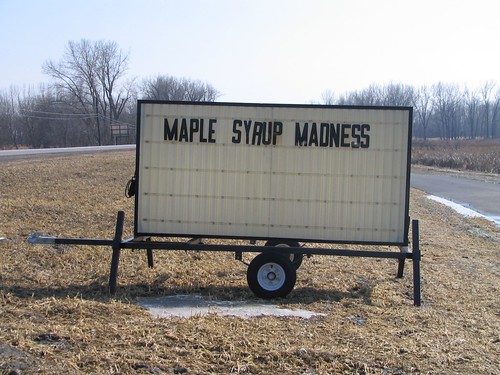
Maple Syrup Madness


Making maple syrup is a harbinger of spring in Minnesota, and a fun way to produce something tasty in your own back yard. We recently attended the "Maple Syrup Madness" event at Wargo Nature Center to get the deets on making our own maple syrup.

Four species of maple can be used for collecting sap in Minnesota. Folks generally prefer the sugar maple or hard maple, (Acer saccharum) because it yields the sweetest sap. However, sap can also be gathered from red maple (Acer rubrum), silver maple (Acer saccharinum), and boxelder (Acer negundo). It doesn't matter where your tree is located - yard trees, street trees, and open grown trees in pastures or woodlands can be used for maple sap production.

To get your hands on the best sap, tapping should be completed by mid-February in central and southern Minnesota and by the second week in March in the northern portion of the state. A tree suitable for tapping should have a 10 inch diameter and be in healthy condition.


To tap a tree, select a spot on the trunk about two to four feet above the ground in an area of the trunk that appears to contain sound wood. Drill a hole about 2 inches deep, slanting it slightly upward. This encourages proper downward flow of the sap.


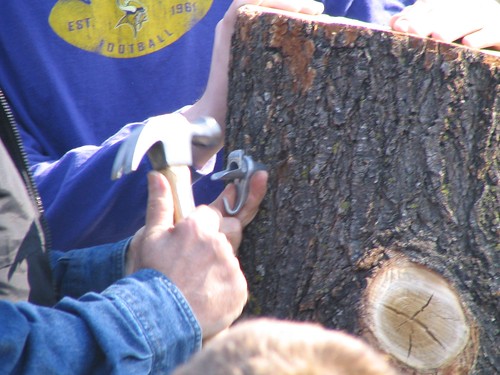
Insert the spile (collection spout) and hammer it lightly into the tree. Attach a collection container to the spile, and make sure the container you use is sealed to keep the pests and debris out.


Sap does not flow from maple trees every day throughout the tapping season. It flows on warm days that follow nights when it drops below freezing. Thus, the amount of sap you collect will vary from day to day. But that's no big deal, right? Empty the collection container daily, and store the sap in your refrigerator or freezer.

Just so you know, sap's sugar concentration is around two percent. At that rate, forty-three gallons of sap are required to produce one gallon of syrup. A single taphole can yield 15 gallons, so you can make about 3 pints of syrup from that tree in your backyard if the conditions are favorable.

Now that you have collected the maple sap, here's how to turn it into maple syrup:

1. Strain the sap through some sort of filter to remove any debris.

2. Boil the sap in a large stainless steel pot or pan. You can build an outdoor firepit, use a camp stove, or even use your gas grill. Boiling outside is your best bet. The syrup steam will make your walls and ceiling sticky.

3. Take the temperature of the sap when it first comes to a boil. This will help you know when it is finished syrup. The temperature will be about 219 degrees for finished syrup. To help keep the sap from boiling over, rub a bit of butter or around the rim of the pan.

9. Strain the finished syrup through again to remove any bits of debris, as well as any crystalized minerals.

10. The sugar content of maple syrup is high enough that it can be stored at room temperature without spoiling. So you can store it in your favorite salvaged maple syrup bottle.

There are tons of resources online to help you make your own maple syrup. University of Minnesota Extension offers these instructions.

Click here to view our full set of photos from Maple Syrup Madness at Wargo Nature Center.

[where: Sustainable Food, Maple Syrup, St. Paul, Minneapolis, Twin Cities, Minnesota]

Monday, March 16, 2009

Reetsy Reviews: Black Forest Inn Sausages

German migration to Minnesota peaked during the decades of the 1860s and 1870s. The historical German opposition to prohibition in Minnesota is reflected in a strong beer making tradition throughout Minnesota, and we have a fair share of German restaurants, to boot.

The Black Forest Inn has been around a long, long time in Minneapolis - 41 years, to be exact. I figured it was about time for me to stop in and try their sausages because it's no secret that I *heart* housemade sausages.

Erich Christ's reasons for making sausages from scratch make sense to me: "At a time when other restaurants were buying more and more of their products finished and pre-packaged we were trying to stay in the same price point, and make our food better, fresher and more interesting."

Interesting sausages made fresh in Minnesota definitely peak my interest. It would be great to see them take "home made" one step farther by sourcing local meats for the sausage they make.

Read more of my thoughts about the meal at www.reetsyburger.com.

[where: Sustainable Food, St. Paul, Twin Cities, Minnesota]

Sunday, March 15, 2009

Reetsy Reviews: The Blue Door Pub

Rave reviews and lines extending out the door made Blue Door Pub too tempting for us.

On a sunny weekend in March we simply had to stop in. The truth is, we'd tried stopping before, but the line around the block was too long for our growling stomachs. We picked 2pm on a Saturday afternoon, and headed to St Paul.

Juicy Blucys, locally produced beer, and Spam bites give this place a distinctly Minnesota feel. It would be thrilling to see them add some locally sourced beef and cheese to their menu to up their Minnesota flavor.

Check out my full writeup at www.reetsyburger.com.

[where: Sustainable Food, St. Paul, Minneapolis, Twin Cities, Minnesota]
Wednesday, March 11, 2009

We Made Meat Pies


We Made Meat Pies
Originally uploaded by gergistheword
1 lb. ground buffalo from Eichten's Hidden Acres Bison
1/2 tsp. salt
1 1/2 tsp. pepper
1/4 tsp. cumin
1 tsp. ground garlic
1 tbsp. celery salt
2 tbsp. basil
1 cup Cedar Grove organic pepper jack cheese
1 cup Cedar Summit milk
4 c. biscuit mix

-Preheat oven to 400 degrees.
-Brown meat and season with the salt, pepper, herbs and spices.
-Make biscuit dough following the instructions on the box (season dough with salt, pepper, and shredded pepper jack).
-Cut dough in 5x3 inch; rectangles, roughly.
-Spoon meat mix on each.
-Fold in half.
-Seal edges.
-1/2 inch apart on greased cookie sheet; bake 12-15 minutes.
-Serve immediately.
-May be made up to 6 hours in advance. But bake just before serving.


Check this out: Locally raised bison is pretty easy to find in Minnesota, and the research tells us that it's better for you than beef. Eichten's Hidden Acres Bison is Minnesota's second largest bison herd. It's reasonably priced, tastes great, and can be purchased at Seward Co-op, as well as other co-ops in the city.

(Per 100 grams of cooked lean meat):
Species Fat Calories Cholesterol Iron
Bison 2.42 143 82 3.42
Beef 9.38 211 86 2.00

Monday, March 2, 2009

Town Talk Diner: Revisited

Town Talk Diner has been a good spot for us and our neighborhood.

For us, Town Talk Diner was our neighborhood joint. We took friends and family there on a regular basis. We celebrated our engagement there. It had been one of our top picks for sharing good times. Needless to say, we were a bit concerned when we heard that Thero's Restaurant Group had purchased the place. We were concerned that their chef-driven, creative, sustainable approach to running a restaurant would be lost.

We stopped in for food and drinks on Saturday. It was our first visit since Town Talk Diner became a Thero's joint.

I was happy to see that Nick and Patrick were still concocting drinks behind the bar, and that the restaurant is still featuring local, sustainable, seasonal ingredients.

The Carr Valley Cheese Curds were still naughty and tasty - fried with capers and paired with bacon ketchup. The duck bomb burgers were juicy and paired with bourbon ketchup. The ladies seated next to us raved about their wine braised pot roast and Fischer Farms pork chop. By 7pm, the dining room was near capacity, as was the bar.

Gerg treated me to a "scotch bonnet" from the current drink menu. It was habañero infused scotch mixed with apricot liqueur and orange bitters. Truly delightful.

They're offering a Sunday Night Supper menu featuring their own version of T.V. dinners - a four course dinner served with a beverage for $18.


[where: Sustainable Food, St. Paul, Minneapolis, Twin Cities, Minnesota]

Monday, February 9, 2009

Reetsy Reviews: Ngon Vietnamese Bistro

February and Saturdays are good for warm lunches with loved ones. My passion for such led me to Ngon Vietnamese Bistro on Saturday with my husband, gerg.

We had read some decent reviews of Ngon, and I was dreaming about a big bowl of pho.

We were so pleased when we arrived and were seated in a brightly lit, clean, sunshiney dining room. They were about 1/3 full, and we were seated promptly. I'm not sure how well the atmosphere would translate into romantic evening dining, but it was great for lunch.

Ngon Vietnamese Bistro has the passion and commitment I've come to appreciate in a restaurant. They are committed to using fresh, local ingredients, and they take it a step farther by offering sustainably-raised meats, which is valuable to me.


We each ordered our own pot of fresh brewed Jasmine tea to start, but they do offer organic and sustainable wines, and local beers.

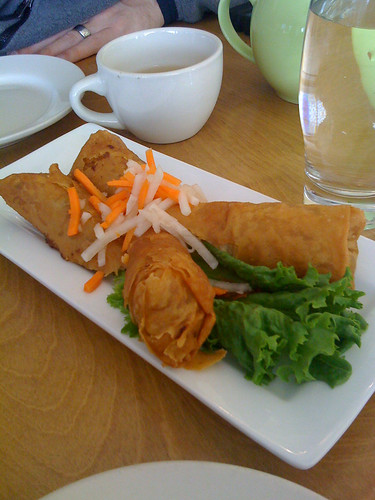
We opened our lunch with an order of the Chả Giò: these are fried egg rolls with stuffed with all natural Fischer Farm pork and glass noodles, and topped with pickled carrot and daikon.


They were seasoned well, and meat was tender. Overall, they definitely ranked more adequately in fried egg roll proficiency than most I've come across, especially at $5.

I'm always pleased when I can order beef at a restaurant. I usually avoid beef entrees because I prefer local, humanely raised, grass fed beef. I've come to appreciate and patronize restaurants that offer that kind of beef on their menu. Thus, I set my site for the pho (pronounced "fuh"), which I had read about on various blogs and review sites. Ngon offers 6 varieties of pho, one with chicken and one with seafood.


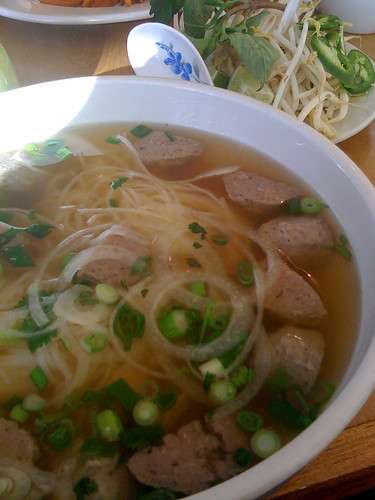
Phở Bò Viên: this version of their rice noodle soup is made with homemade meatballs using all natural 100% grass fed beef, and topped with green onion . The meatballs were tender. The subtle, savory broth was not overly salted and was prepared with oxtail from all natural grass fed cattle. The pho was served with a generous portion of fresh ingredients on the side, which you add as desired:

Per tradition, this plate of fresh Asian basil leaves, bean sprouts, chilies, and lime wedges were served on a separate plate with the pho; you add them by and by, as you consume the soup - chopsticks in one hand, spoon in the other. I also added a touch of chili sauce to mine. The oxtail broth steamed with the aroma of beef, ginger, green onions, and cilantro. As I added the fresh basil and squeezed the lime into the bowl, I was pleased with the freshness of the ingredients. All of this was served up for $8.95. Apparently, I ceased talking to gerg at some point, spellbound by my pho.

Gerg ordered the Bánh mì: a vietnamese pork sandwich, traditionally served in pho shops.

Ngon's pork sandwich is grilled Duroc natural pork loin on a baguette topped with pickled vegetables and cilantro, and plated with house cut sweet potato fries. I've heard Duroc referred to as a "grill’s best friend" and that certainly helped this sandwich. The juicy, rich grilled meat was topped with crispy sliced pickled carrots, daikon, cilantro and some onion. The spicy aioli served on the side was surprisingly traditional as well. Does the whole thing seem a little French to you? Me too. Apparently, the whole concept of this sandwich is a product of French colonialism in Indochina - thus baguettes and mayonnaise are paired with native Vietnamese ingredients like pickled vegetables and cilantro for $8.50.

Vegetarians will note the section of vegetarian entrees on the menu, including their Hù Tiếu Chay: rice noodles, fresh shitaki mushrooms, daikon, carrots, bok choy and green beans in vegetable broth.

We liked our lunch, and will be back again. I'm still eager to try the Vietnamese crepe, the beef brisket pho, the Vietnamese coffee cake, and, OF COURSE, the crispy rabbit dumplings.

Get your pho on!
Ngon Vietnamese Bistro
799 University Ave
St. Paul, MN
(651) 222-3301

[where: Ngon Vietnamese Bistro, Sustainable Food, St. Paul, Twin Cities, Minnesota]